From Organic Farming to Biodiversity: Hualien Joins Global Stage to Explore Sustainable Agriculture
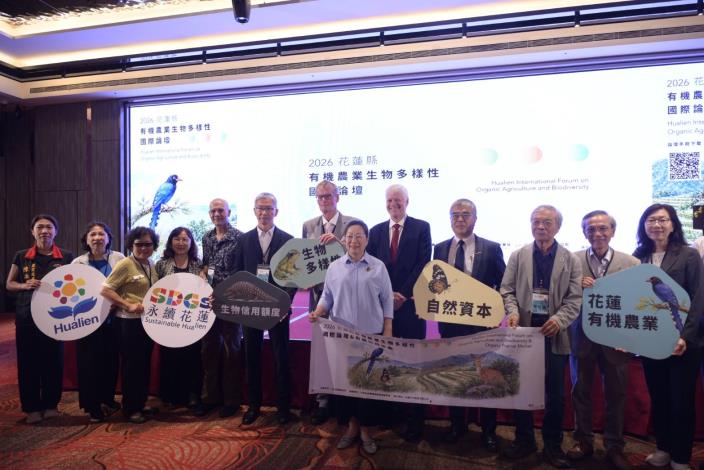
Facing global challenges of climate change and biodiversity loss, alongside growing international focus on natural capital and sustainable investment, the Hualien County Government hosted the “2026 Hualien International Forum on Organic Agriculture and Biodiversity” today (Sept. 30). The event brought together domestic and international experts, scholars, government officials, industry leaders, and researchers in Hualien. Participants exchanged international trends and practical experience across global conservation, natural capital, biodiversity credits, and sustainable agriculture in Asia, jointly exploring new possibilities for organic farming to thrive in harmony with nature.
Speaking at the forum, Hualien County Magistrate Hsu Chen-Wei expressed her gratitude to local farmers and farmers’ associations across all townships and cities for their long-term commitment and dedication. Their efforts have helped organic farming take deep root in Hualien, with certified organic farmland continually expanding to approximately 4,054 hectares by the end of June this year—maintaining Hualien’s top position nationwide. Hsu emphasized that this achievement reflects years of steady, step-by-step effort by local farmers. Blessed with a valuable and diverse agricultural environment, the county government continues to promote organic farming and environmentally friendly agriculture while advancing spatial planning based on sustainable resource use. This approach balances agricultural production with the protection of land, water resources, and critical farming infrastructure, moving steadily toward Hualien’s goal of becoming Taiwan’s first net-zero city.
Hsu noted that agriculture is more than food production; it is deeply connected to the land, ecosystems, and people’s daily lives. Beyond the commercial value of their produce, farmers’ long-term dedication yields healthy soil, thriving ecosystems, rich biodiversity, and the natural value nourished by the land. Hualien’s recent extension from organic farming to biodiversity aims to strike a balance between agricultural development and environmental conservation, addressing a core question: “What kind of land do we want to leave to the next generation?” Only by continuously cherishing the land, practicing eco-friendly farming, and safeguarding ecosystems can Hualien sustain its agricultural development and pass this land’s vitality down through generations.
The forum featured international experts Dr. Tim Coles, Dr. Harvey Locke, and Dr. Reza Azmi, who traveled to Hualien from the United Kingdom, Canada, and Malaysia, respectively, to share frontline experiences in global conservation, nature finance, and sustainable agriculture in Asia. The event also convened representatives from relevant central government agencies, farmers’ and fishermen’s associations, financial institutions, organic certification bodies, eco-friendly farming groups, conservation organizations, universities, and interested members of the public, enabling diverse fields to engage in a shared discussion on the future of agriculture and biodiversity from their respective expertise and practice.
In 2025, the Hualien County Government officially launched the “Research Project on a Biodiversity Credit Methodology for Organic Agriculture in Hualien County.” Through scientific research, local field verification, and international exchange, the project seeks to progressively evaluate the benefits that organic agriculture brings to the land, ecosystems, and biodiversity. It aims to make previously less visible natural values scientifically understood and measurable, while exploring potential connections with industries, corporate partners, and markets—marking a crucial step in expanding Hualien’s focus from organic agriculture to biodiversity, and from agricultural production to sustainable development.
Tsai Ming-Jer, Chairman of the Chinese Climate Change and Agricultural Development Society, stated that the development of biodiversity credits should not stop at whether a farm holds organic certification; more importantly, it should move toward an “outcome-based” approach to understand the actual ecological changes brought about by different agricultural management practices. Moving forward, scientific data on habitat quality, bioindicators, functional species, and soil ecology can be used to evaluate the ecological benefits generated by agricultural production and management, providing a more objective basis for measuring changes in biodiversity. Only by continuously accumulating scientific and local data can the actual ecological contributions of organic agriculture be presented more clearly, establishing a more robust foundation for the future development of biodiversity credits.
Chen Shu-Wen, Director-General of Hualien County’s Department of Agriculture, explained that biodiversity credits remain an emerging and evolving field globally. At this stage, Hualien is not rushing to provide a set of predefined answers, but rather focusing on doing the foundational work well. Through scientific research, international exchange, and local field verification, the county aims to systematically inventory the ecological benefits created by agricultural production, understand the long-term natural value accumulated through organic farming, and identify a development path suited to Hualien’s local conditions.
Chen pointed out that hosting this international forum aims to bring global experience into Hualien while showcasing Hualien’s long-standing organic farming practices to a wider audience, fostering a dialogue between global trends and local experience. Alongside the professional discussions, an organic pop-up market themed “Organic Agriculture × Biodiversity × Sustainable Consumption” was held on-site, bringing together local farmers and brands to showcase Hualien’s agricultural achievements. This allowed attendees not only to hear about Hualien in the conference room but also to visually experience and taste the reality of Hualien’s agriculture. From a grain of rice and a cup of tea to various specialty farm products, every item reflects a farmer’s commitment to the land and tells a story unique to Hualien.
The forum was more than just an international exchange; it served as an opportunity to build on Hualien’s long-standing organic foundation and deeply reflect on the relationship between agriculture and biodiversity. Through dialogue between international experience, scientific research, and local practice, Hualien aims to progressively build a broader base of local data and experience, enabling more people to understand the ecological and natural value generated by organic agriculture.
Looking ahead, Hualien will continue using organic agriculture as a foundation to deepen connections among farming, ecology, and local industries. Guided by scientific research, field verification, and international exchange, the county will explore a path toward sustainable development tailored to Hualien’s natural environment and agricultural characteristics. Starting from organic agriculture to live in harmony with nature, and reaching out from Hualien to engage with the world, every step taken to protect the land will leave greater possibilities for the next generation.
Sources: Hualien County Government
