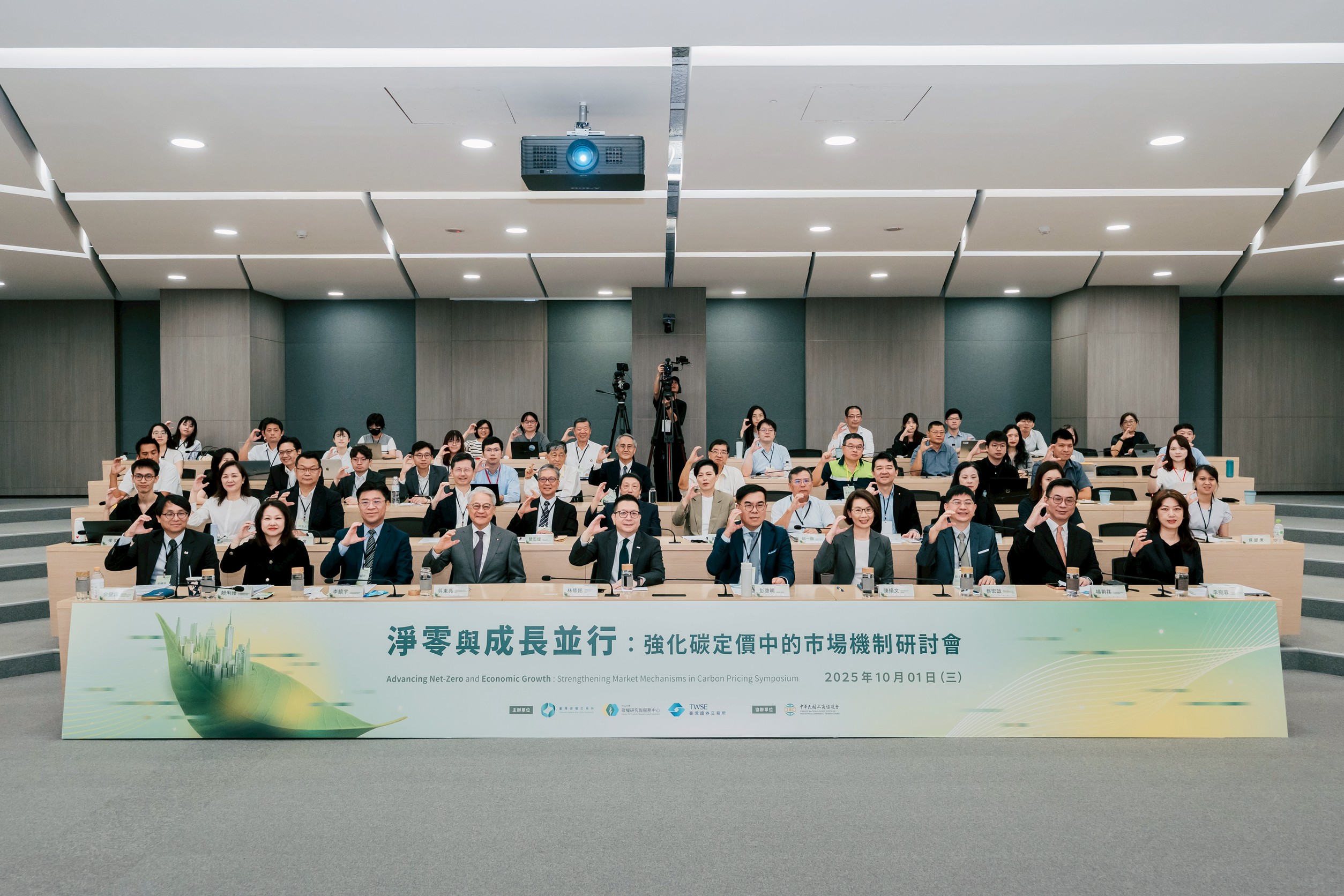

To help enterprises accelerate decarbonization and promote a low-carbon economic model, the Taiwan Carbon Solution Exchange (TCX) and the Taiwan Stock Exchange (TWSE) commissioned the Center for Carbon Research and Solutions of National Sun Yat-sen University (NSYSU), in collaboration with the Chinese National Association of Industry and Commerce (CNAIC), to host the “Advancing Net-Zero and Economic Growth: Strengthening Market Mechanisms in Carbon Pricing Symposium.” The event invited Minister of Environment Dr. Chi-Ming Peng to deliver a keynote speech and gathered 12 representatives from industry, government, and academia for a cross-sector dialogue among the “Finance–Industry–Green Growth League.” The seminar attracted more than 100 participants from various industries. As the Ministry of Environment advances Taiwan toward a dual-track carbon pricing framework combining carbon fees and the emissions trading system (TW ETS), the seminar aimed to address urgent industrial needs and explore future prospects, fostering collaboration to achieve both carbon reduction and economic growth.
TWSE and TCX Chairman Sherman Lin remarked that as a bridge between policy and market, TCX is committed to assisting the government in building the carbon market and institutional framework, striving to create a fair competitive environment for industries while strengthening international alignment. CNAIC Chairman Tong-Liang Wu emphasized that under a dual-track carbon pricing system, carbon reduction is not just a cost but can also become an asset. He added that CNAIC will continue close communication and coordination with relevant government agencies to integrate environmental policy with industrial transformation and financial innovation, achieving mutual prosperity and shared success.
Keynote Speech: The Outlook for Taiwan’s Carbon Pricing Market Mechanisms
Minister of Environment Dr. Chi-Ming Peng stated that while Taiwan’s climate governance has shown promising initial results, future growth must be guided by green strategies to ensure long-term sustainability. He reaffirmed the government’s determination to promote carbon pricing and market mechanisms. Minister Peng also noted that earlier this year, he led members of the Green Growth League and TCX to Germany to study the mature experience of the European Union Emissions Trading System (EU ETS). Looking forward, he hopes the financial sector will also actively participate in shaping Taiwan’s dual-track carbon pricing framework. He further tasked TCX with planning the pilot TW ETS trading platform and developing green talent training programs. The Ministry will continue to strengthen regulatory development and international collaboration, encouraging Taiwanese industries to engage in international cooperation projects, such as partnerships with Paraguay, to achieve shared decarbonization outcomes.
Financial Perspectives: New Investment Landscape in the Carbon-Priced Era
Moderated by Dr. Masson Li, Chief Economist and Chief Sustainability Officer of TS Financial Holding Co., Ltd., this session featured Robert Yang, Chief Administrative Officer and CSO of Yuanta Financial Holdings; Wang-Jung Li, Head of Sustainability Strategy at Mega Financial Holdings; and Li-Chen Lai, Senior Vice President and CSO of KGI Financial Holdings. Together, they discussed how the “carbon pricing era” is reshaping industrial competitiveness. Each speaker shared insights into the processes, standards, and benefits of adopting internal carbon pricing. The panel emphasized the financial sector’s critical role in climate risk management and resource allocation, highlighting that carbon management data is essential in assessing clients’ decarbonization competitiveness. By directing capital toward sustainable innovation, financial institutions can become key drivers of industrial low-carbon transformation.
Industrial Perspectives: Transition Pressures and Market Opportunities
From the viewpoints of the chemical, transportation, and construction industries, this session explored how sectors are responding to the challenges and opportunities of achieving net-zero. Moderated by Professor Chien-Yuan Sher, professor from Center for Carbon Research and Solutions of NSYSU, panelists included Ying-Hsuan Yu, Associate Director of Oriental Union Chemical Corporation; Professor Shyue-Koong Chang, Director of the Advanced Transportation Research Center at the University of Taipei; and Shih-Chi Lo, Section Chief at the Architecture and Building Research Institute, Ministry of the Interior. Ying-Hsuan Yu shared that Oriental Union Chemical has long been investing in carbon capture technology and implementing process and equipment improvements to achieve tangible emission reductions. Shih-Chi Lo noted that the building and housing sector accounts for about 20% of Taiwan’s total carbon emissions, representing major potential for national reduction. The Institute will continue promoting nearly zero carbon buildings capable of achieving up to 50% energy savings. Shyue-Koong Chang emphasized that achieving net-zero in transportation requires not only electrification and decarbonization but also integration with transit-oriented urban planning and design, encouraging behavioral change through a “Net-Zero Green Living” approach.Green Growth League: Sharing Practical Experience of Early Movers
As core participants in the TW ETS pilot phase, representatives from Taiwan Cement Corporation (TCC), Delta Electronics, and China Steel Corporation (CSC) shared their decarbonization journeys and international cooperation achievements. Moderated by Professor Hung-Cheng Tsai, Director of Center for Carbon Research and Solution of NSYSU, the session featured TCC Vice President and CSO Shelly Yeh, who discussed how TCC has turned international competitive pressures into new low-carbon revenue growth and called for engineering policies that promote low-carbon innovation. Chih-Wei Chang, Section Chief at CSC’s Environmental Protection Department, analyzed how global steelmakers address carbon pricing and expressed hopes for Taiwan to draw from international best practices in establishing its own TW ETS. Delta Electronic Vice President and CSO Jesse Chou shared experience implementing internal carbon pricing in Delta Electronic, which has helped the company identify emerging green business opportunities such as hydrogen energy.
With the implementation of the carbon fee and the progress of the TW ETS system, Taiwan is steadily entering an internationally aligned carbon pricing era. Through a well-designed carbon pricing market and active participation across all sectors, Taiwan aims to strengthen its footing in the global net-zero movement and open new opportunities for green growth. TCX and TWSE will continue to align with government policies, fostering public–private cooperation to achieve a balance of “decarbonization and growth, competition and sustainability,” showcasing Taiwan’s resilience and sustainable competitiveness on the path toward net-zero.
Sources: Taiwan Carbon Solution Exchange
