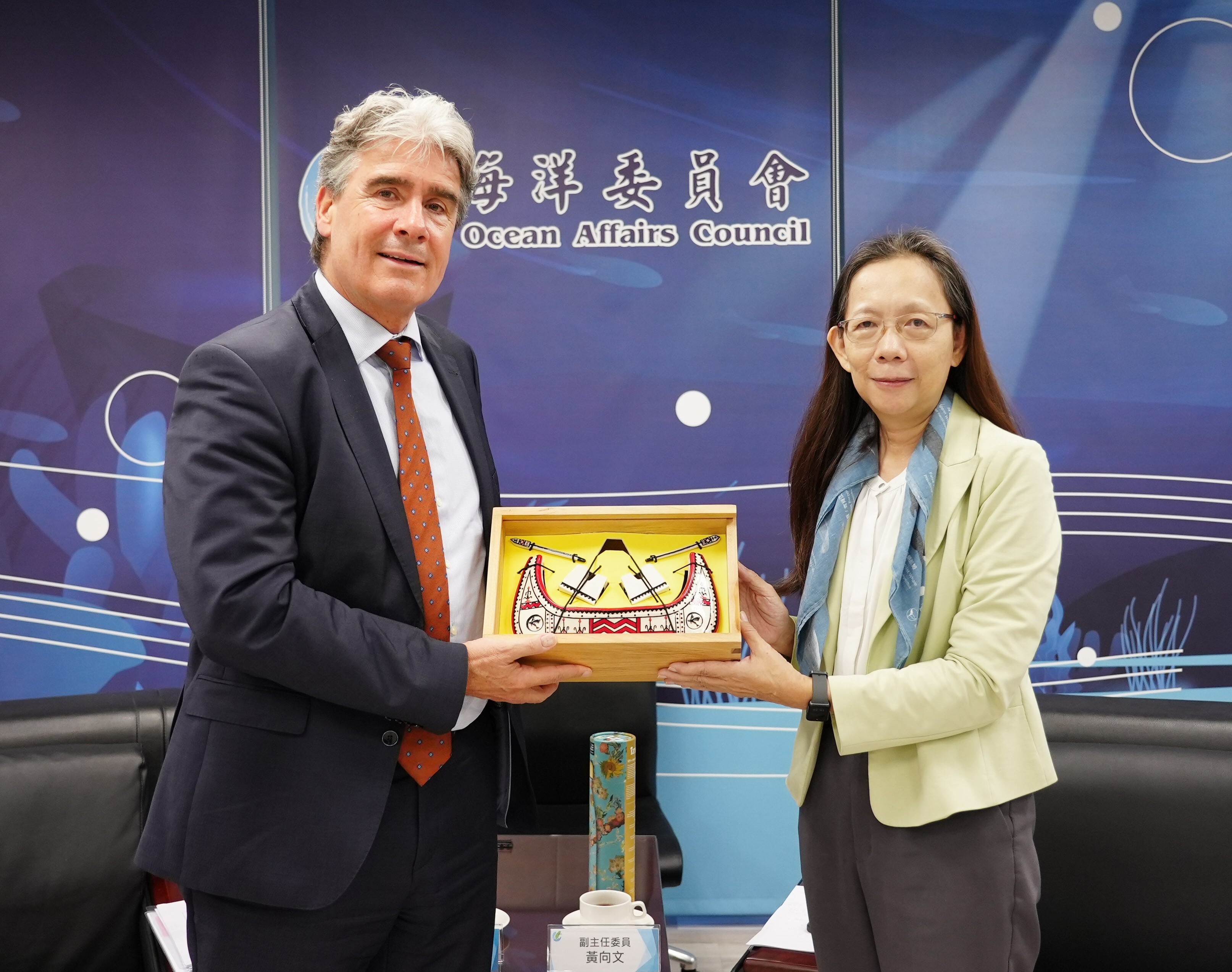
The delegation led by Representative Bas Pulles and Mr. Ulco Gartner, Director of Administration & Consular Affairs, from The Netherlands Office Taipei visited the Ocean Affairs Council (OAC) yesterday afternoon (11th), where they were received by Deputy Minister Huang Hsiang-wen. Both sides engaged in in-depth discussions on the long-standing maritime cooperation between Taiwan and the Netherlands, as well as topics including energy transition, marine spatial planning, maritime security, and pollution prevention. They also expressed hopes to further strengthen collaboration in marine sustainability and the blue economy.
Deputy Minister Huang noted that the Netherlands possesses world-leading expertise in water governance, port management, marine spatial planning, and green energy deployment. As maritime nations, Taiwan and the Netherlands share a strong commitment to a rules-based international order and sustainable development. In the face of cross-border challenges such as climate change, energy transition, and maritime security, both sides agreed on the importance of enhancing institutional and technical exchanges to bolster overall governance resilience.
Huang further emphasized that the OAC plays a key role in integrating Taiwan’s marine industries, energy development, and marine spatial planning efforts. With the Netherlands’ advanced experience in water governance, offshore wind energy, hydrogen development, and carbon capture and storage (CCS), the two countries hold highly complementary strengths in advancing the green transition. Representative Bas Pulles stated that this visit aims to strengthen engagement with Taiwan’s energy, environmental, and semiconductor sectors, with the hope of fostering broader cross-sector cooperation.
Representative Pulles also highlighted marine spatial planning as one of the most promising areas for cooperation between Taiwan and the Netherlands. With the rapid expansion of offshore wind energy, the reality of limited marine space has become increasingly apparent. The Netherlands is proactively promoting “multi-use” policies to address spatial competition with existing industries such as fisheries, ecological conservation, shipping, and national defense. Demonstration projects include aquaculture and seaweed cultivation within wind farm areas, ecological restoration initiatives, and the integration of floating solar systems—all designed to balance energy production, ecological needs, and industrial activities within shared marine spaces. He also noted nature-based solutions and Taiwan–Netherlands exchanges on sandbar development as potential future areas of collaboration.
Both sides also discussed marine pollution management and maritime emergency response. The Dutch delegation shared its capabilities in efficient maritime salvage operations and experience with international pollution-prevention efforts. The OAC expressed its willingness to work with the Netherlands on advancing marine debris management initiatives, jointly contributing to a cleaner and healthier ocean.
The OAC stated that it looks forward to further deepening Taiwan–Netherlands cooperation in marine governance, marine spatial planning, and sustainable development. Together, both sides seek to address challenges related to climate change, energy transition, and maritime security, and to build a more resilient and sustainable ocean future.
Sources: Ocean Affairs Council
