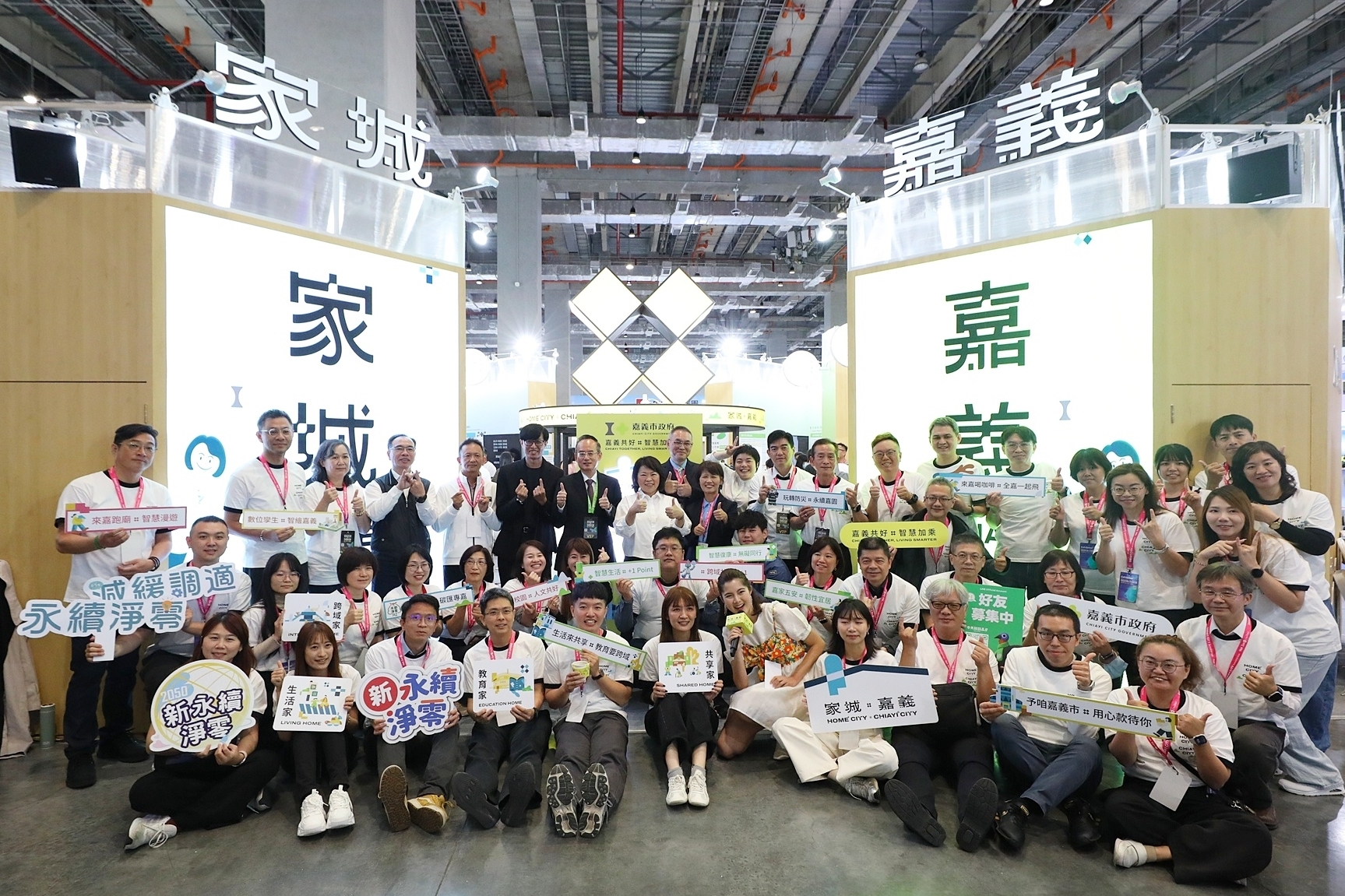


The 2026 Smart City Summit & Expo, one of Asia’s largest events of its kind, opened on March 17 at Taipei Nangang Exhibition Center Hall 2. The Chiayi City Government is participating under the theme “Home City × Chiayi,” bringing together 16 departments and 15 initiatives to present its cross-department smart governance achievements. The city’s pavilion is the largest among non-special municipality exhibitors. Mayor Huang Min-hui led the delegation at the opening ceremony, highlighting progress in smart transportation, net-zero governance, smart tourism, and digital education. Vice President Hsiao Bi-khim also visited the pavilion and spoke highly of its design and exhibits.
Mayor Huang noted that Chiayi City’s scale enables flexible policy implementation and cross-sector coordination. By integrating design thinking into governance, the city develops solutions that act as a "living lab," where local experiments in Chiayi pave the way for national implementation. Several initiatives have been adopted by other local governments, including the AI-powered Smart Patrol System developed by the Chiayi City Police Bureau. Additional projects, such as AI-based water safety detection and carbon monitoring, further demonstrate the city’s approach to applying technology in public governance.
Mayor Huang stated that the city’s participation in the expo reflects its ongoing efforts to integrate governance experience with technological innovation. Through cross-department collaboration, Chiayi City continues to translate smart technologies into practical public services, strengthening both efficiency and accessibility.
The “Home City × Chiayi” pavilion draws inspiration from the city’s landmark Central Fountain (Central Seven-Way Roundabout) and woodcraft heritage, and is organized into four thematic zones: “Smart Living,” “Cross-Domain Integration,” “Shared Services,” and “Smart Education.” In the Smart Living zone, applications in transportation safety and environmental governance are presented. For example, an AI-powered alert system at unsignalized intersections uses camera and radar detection to identify approaching vehicles and provide real-time alerts, contributing to a 40.28 percent reduction in related traffic accidents. Drone-based monitoring combined with Geo-AI technology is also applied to support urban carbon management.
Other exhibits include integrated public service kiosks combining land administration and taxation services, AI-supported travel planning, smart care services, and digital learning platforms. These initiatives demonstrate how the city integrates services across departments to enhance user experience and service delivery.
According to Planning Department Director Tseng Chiang-ping, Chiayi City’s approach emphasizes both technological development and the human dimension of urban governance. The exhibition runs through March 20, and visitors are invited to explore how the city integrates technology and local characteristics to build a livable and inclusive environment.
Sources: Chiayi City Government
