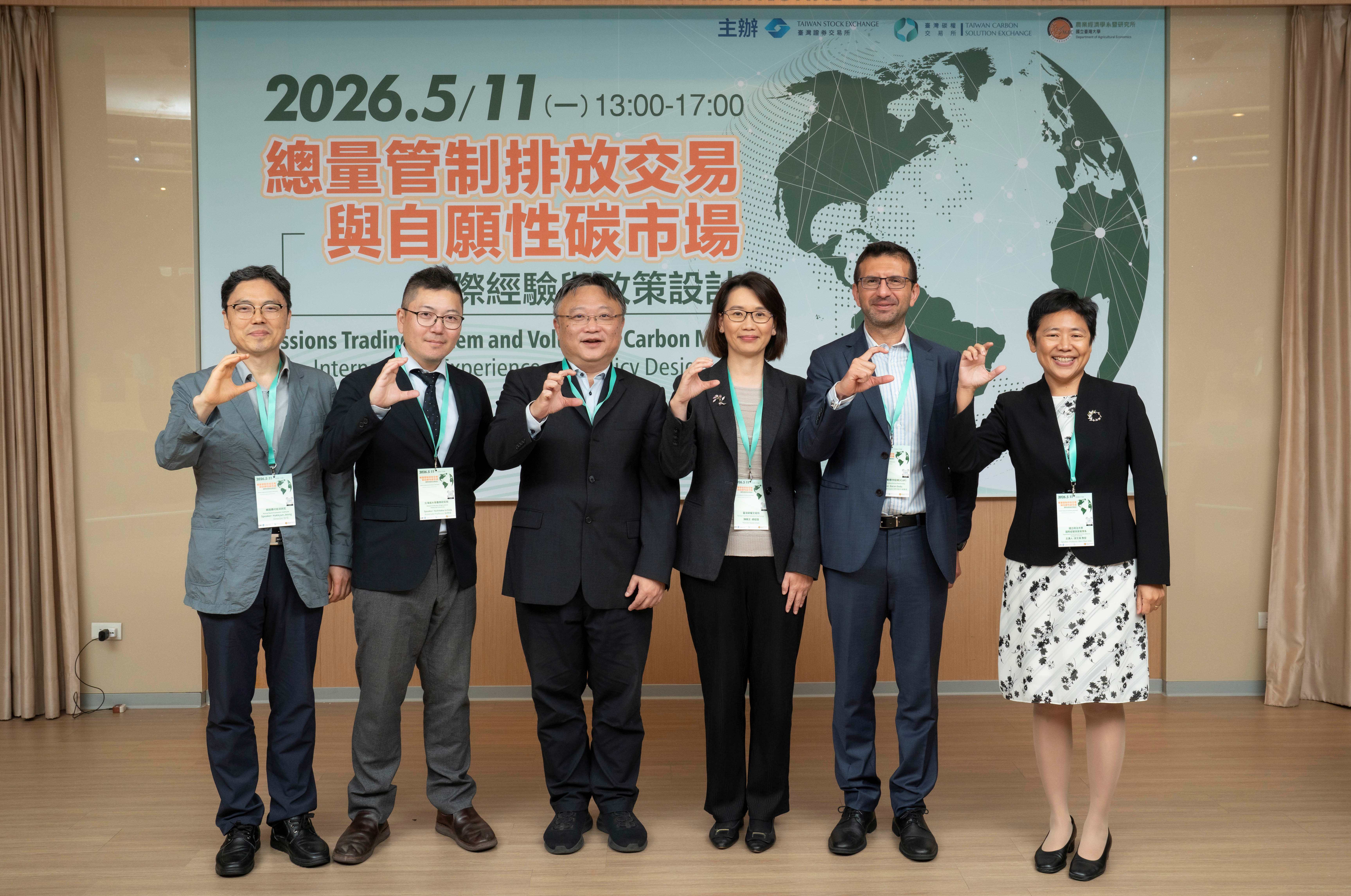

As global carbon pricing accelerates, Taiwan is implementing its carbon fee system while actively exploring the roadmap toward a comprehensive Taiwan Emissions Trading System (TW ETS). To facilitate this dialogue, the Taiwan Carbon Solution Exchange (TCX), the Taiwan Stock Exchange (TWSE) and National Taiwan University hosted the forum “Emissions Trading System and Voluntary Carbon Markets: International Experience and Policy Design” on May 11, 2026. This international forum gathered experts from Taiwan, Japan, South Korea, and Germany to explore the alignment between ETS and voluntary markets and how carbon markets can drive agricultural transformation, leveraging global expertise to chart feasible policy pathways for Taiwan.
Ms. Seren Chen, CEO of TCX, opened the forum by highlighting that tightening mandatory markets and voluntary mechanisms are shaping global trends as Taiwan builds its ETS. She emphasized TCX key milestones last year, from signing an MoU with EEX for market infrastructure to advancing forestry carbon projects, leveraging global experience to guide a practical and credible pathway for Taiwan.
Market Incentives: Driving Agricultural Decarbonization and Innovation
Dr. Yoshitaka Uchida, Associate Professor at Hokkaido University, stressed that achieving net-zero must not compromise food productivity. He noted that mechanisms like J-Credit provide economic incentives for practices like Alternate Wetting and Drying (AWD) for rice cultivation and biochar application. These projects boost carbon reduction and sequestration while channeling capital to revitalize rural communities.
Dr. Hakkyun Jeong, Director at the Korea Rural Economic Institute (KREI), noted that agricultural mitigation is highly challenging due to dispersed emissions. To address this, Korea leverages voluntary carbon markets to turn practices like biogas plants into farmer revenue. He emphasized that governments must establish credible verification and encourage project aggregation to lower costs for small-scale farmers.
System Integration: Building Credible Carbon Trading Frameworks
Professor Wen-Chen Shih of National Chengchi University (NCCU) analyzed how voluntary and compliance markets align. She noted that while an ETS drives industrial abatement, voluntary mechanisms channel climate finance into non-regulated sectors like agriculture. To ensure market integrity, credits must rely on rigorous verification and environmental integrity to guarantee real emissions reductions.
Dr. Baran Doda, Senior Carbon Market Specialist at the International Carbon Action Partnership (ICAP), suggested that Taiwan could adopt intensity-based caps rather than absolute caps to balance economic growth. He emphasized that Taiwan's carbon fee and future ETS are complementary, noting that a robust domestic pricing mechanism is key to addressing EU CBAM challenges and keeping revenue within the country.
Panel Discussion: International Experts Navigate Agriculture and Carbon Pricing Transition
Moderated by Professor Wen-Chen Shih, the panel explored methodology design and pricing integration. For agricultural projects, Dr. Uchida and Dr. Jeong agreed on leveraging industry structures and economic incentives, suggesting that targeting key value-chain players and developing cost-effective methodologies can accelerate farmer participation. Regarding policy transition, Dr. Doda praised Taiwan’s conditional carbon fee rates as aligned with the EU ETS trend of conditional free allocations, adding that Taiwan's roadmap from carbon fees to an ETS mirrors the sector-specific transition experiences of Germany, Austria, and France.
By exchanging international practices and policy insights, this forum provides critical guidance for Taiwan to develop its TW ETS and voluntary carbon markets. The TCX will continue supporting national policies, helping businesses transform decarbonization challenges into sustainable competitiveness to collectively achieve Taiwan's 2050 net-zero goal.
Sources: Taiwan Carbon Solution Exchange
