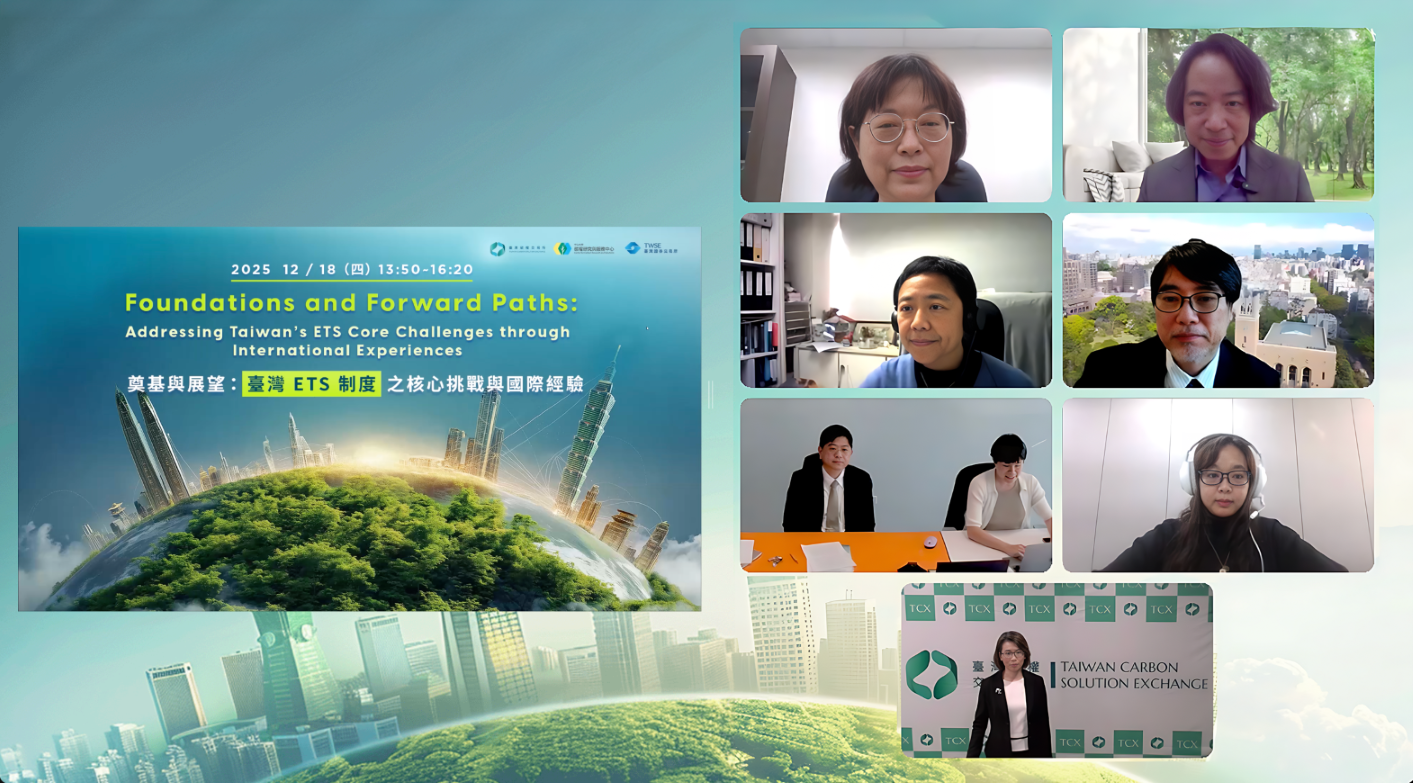
As global carbon pricing accelerates, Taiwan is implementing its carbon fee system while actively exploring the roadmap toward a comprehensive Emissions Trading System (ETS). To facilitate this dialogue, the Taiwan Carbon Solution Exchange (TCX), the Taiwan Stock Exchange (TWSE), and the Center for Carbon Research and Solutions (CCRS) of National Sun Yat-sen University hosted the webinar "Foundations and Forward Paths: Addressing Taiwan’s ETS Core Challenges through International Experiences" on December 18, 2025, attracting nearly 300 professionals.
Ms. Seren Chen, CEO of TCX, kicked off the forum by outlining the Ministry of Environment’s roadmap, highlighting plans for a Taiwan ETS (TW ETS) pilot simulation in the second half of 2026. She emphasized that TCX is strengthening market infrastructure to ensure a stable and transparent environment for future trading, aiming to provide economic incentives essential for corporate transformation in AI and Green Technology.
Dr. Ling-Yi Tsai, Director General of the Climate Change Administration, Ministry of Environment (MOENV), elaborated on the strategic priorities for ETS design, underscoring the need to balance decarbonization with industrial growth. To ensure seamless integration with the carbon fee system launching in 2025, Taiwan will roll out a voluntary pilot simulation as a first step, aiming to complete the legal framework by 2030. This phased approach is designed to avoid double regulation and provide industries with regulatory certainty.
Professor Hung-Jeng Tsai, Director of the CCRS at NSYSU, pointed out that the structural industrial parallels among Taiwan, Japan, and South Korea provide a robust framework for strategic benchmarking, particularly in designing emission caps that align with economic priorities.
Cross-Border Insights: Navigating Policy Design and Challenges
Professor Toshi H. Arimura of Waseda University, shared how Japan’s GX-ETS leverages transition bonds to incentivize participation and will implement price stability mechanisms in 2026. Ms. Maureen Lee, Senior Carbon Market Researcher at Ecoeye, explained that South Korea’s K-ETS Phase 4 will tighten emission caps and deploy the Market Stability Reserve (K-MSR) to enhance liquidity. Professor Wen-Chen Shih of National Chengchi University (NCCU) urged that system design must align with Taiwan's legal framework while being anchored in environmental integrity, economic efficiency, and political acceptability.
Strategic Path Forward: Navigating the Next Steps
In the panel moderated by Dr. You-Ren Wang, Section Chief at the CCRS at NSYSU, experts explored key issues such as securing industrial support and setting reasonable emission caps. The panelists emphasized that Taiwan should utilize pilot mechanisms and incentives to foster corporate trust. For practical implementation, the panel recommended drawing from Japan's bottom-up consensus-building model used in the GX-ETS. Regarding goal setting, experts advised referencing South Korea’s K-ETS Phase 4 to align future emission caps with National Determined Contribution (NDC).
Through the exchange of insights from international experts, this symposium provided critical policy references for aligning Taiwan with global carbon pricing frameworks. As Taiwan launches its carbon fee system, TCX and TWSE stand committed to a holistic ecosystem integrating voluntary credits program, the ETS, and Carbon Border Adjustment Mechanism (CBAM) alignment, positioning Taiwan as an Asian benchmark for climate governance.
Caption: Key speakers at the "Foundations and Forward Paths" webinar.
Top Row (L-R): Dr. Ling-Yi Tsai (MOENV) and Dr. You-Ren Wang (NSYSU). Second Row (L-R): Prof. Wen-Chen Shih (NCCU) and Prof. Toshi H. Arimura (Waseda University). Third Row (L-R): Prof. Hung-Jeng Tsai (NSYSU) and Ms. Maureen Lee (Ecoeye). Bottom: Ms. Seren Chen (CEO, TCX).
Sources: Taiwan Carbon Solution Exchange
