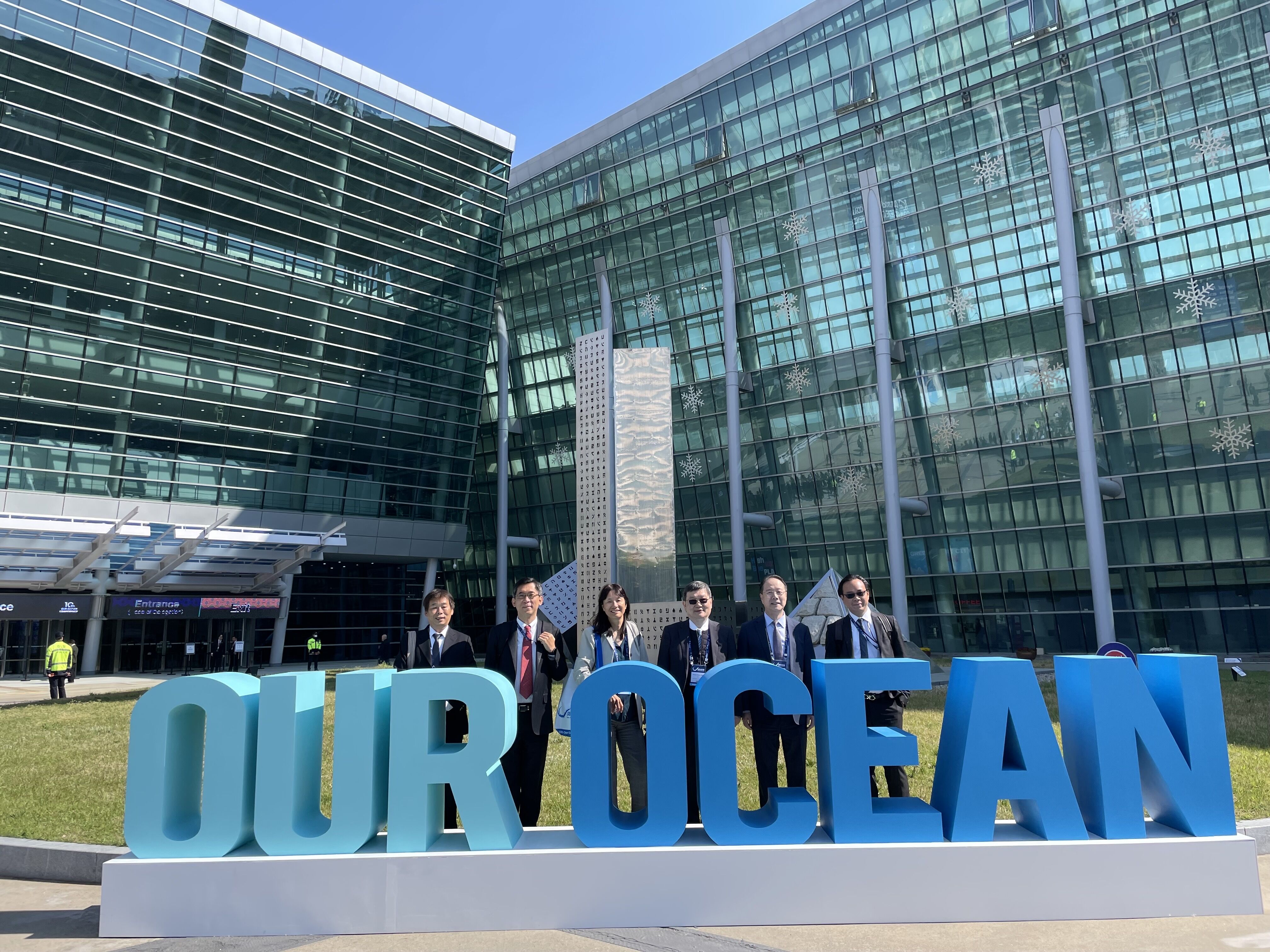
The 10th Our Ocean Conference (OOC 10) took place from April 28 to 30 in Busan, South Korea. Taiwan demonstrated its unwavering commitment to global ocean sustainability by sending a delegation led by the National Academy of Marine Research (NAMR) under the Ocean Affairs Council (OAC), joined by representatives from the Ministry of Foreign Affairs, the International Cooperation and Development Fund, and other institutions—11 members in total.
This year, Taiwan made seven new commitments to sustainable oceans, held 14 bilateral meetings, and was invited to speak at six official side events. Notably, NAMR successfully hosted its own side event themed “Smart Ocean Data Applications,” which received widespread acclaim both at home and abroad. Minister Kuan Bi-ling, Chairperson of the OAC, expressed strong support for NAMR’s continued innovation and engagement in international ocean affairs.
Established in 2014, the Our Ocean Conference has grown into one of the most influential global platforms for dialogue on ocean governance. This year’s conference garnered 277 new commitments totaling USD 9.1 billion, and brought together ocean policy leaders, international organizations, NGOs, and private sector representatives from over 100 countries. Taiwan’s delegation actively participated in policy dialogues, technical exchanges, and advocacy, showcasing the nation’s strengths and initiatives in digital governance, marine technology, and regional cooperation.
Minister Kuan, a vocal advocate for Taiwan’s ocean diplomacy, promotes a threefold strategy: active international engagement, hosting global conferences domestically, and creating international cooperation platforms. She emphasized that as an island nation, Taiwan must not be absent from global ocean governance discussions. Instead, Taiwan should leverage its technological expertise, sound policy framework, and international partnerships to make institutional contributions toward sustainable development. She also praised NAMR’s successful side event, which drew enthusiastic responses and highlighted Taiwan’s capabilities in smart oceans and data governance.
With support from the Ministry of Foreign Affairs and the International Cooperation and Development Fund, Taiwan’s delegation conducted 14 bilateral meetings with allies and like-minded nations such as Palau and Saint Kitts and Nevis, strengthening bilateral cooperation and policy exchange. Through these efforts, Taiwan demonstrated its concrete contributions to regional development cooperation. NAMR has evolved beyond a research institution into a key platform for international collaboration and engagement, playing a more active role on the global stage of ocean governance.
NAMR’s side event, “Smart Ocean Data Applications: Advancing Toward a Sustainable Future,” brought together experts from Japan, South Korea, the Marshall Islands, and Taiwan. Discussions focused on innovative uses of digital tools for sustainable management, including ocean information platforms, data sharing mechanisms, cost-effective operations, and policy applications. The session drew a full house of youth leaders, researchers, and representatives from international organizations. The vibrant exchange underscored Taiwan’s depth of expertise and openness as a knowledge-driven maritime nation.
The Ocean Affairs Council reaffirmed its commitment to advancing international engagement and regional connectivity through professionalism and pragmatism. In collaboration with diplomatic and development partners, Taiwan will continue to contribute to global ocean sustainability and work hand-in-hand toward a resilient and inclusive blue future.
Sources: Ocean Affairs Council
