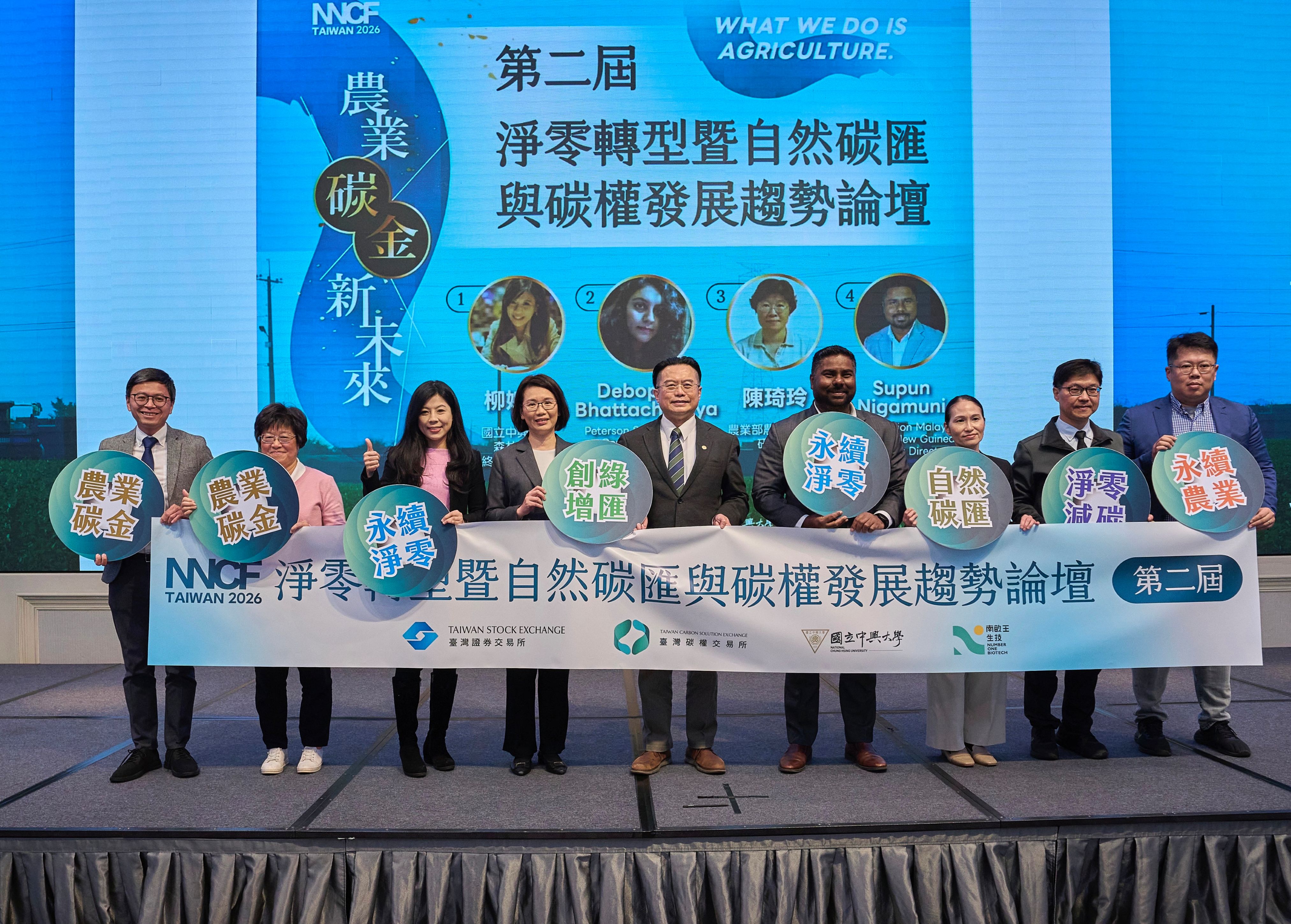

Caption: (From left) Dr. Cheng-Hsien Lin (NCHU); Dr. Chi-Ling Chen (MOA); Professor Wan-Yu Liu (NCHU); Ms. Seren Chen (TCX); Prof. Jenn-Ming Song (NCHU); Mr. Supun Nigamuni (Control Union); Ms. Kazumi Watanabe (Peterson Solutions); Mr. Tenna Tseng (Control Union Taiwan); and Mr. Aven Lin (Number One Biotech)
To address the global net-zero transition and the rising trend of nature-based solutions, the Taiwan Stock Exchange (TWSE), the Taiwan Carbon Solution Exchange (TCX), and National Chung Hsing University (NCHU) co-hosted the " Nature-based Solutions (NbS) and Carbon Projects Forum " . The event focused on regenerative agriculture and soil management, attracting over 200 industry professionals.
Ms. Seren Chen, CEO of TCX, opened the forum by defining the strategic value of carbon credits: “Reducing corporate emissions is about ‘doing the right thing,’ while carbon credits turn those efforts into ‘valuable assets.’” She highlighted the "Taiwan Nature-Based Solutions & Sustainability Initiative," emphasizing that the Yunlin soil carbon project enhances food security and environmental resilience while driving domestic carbon sink development to achieve Taiwan’s net-zero goals.
Professor Jenn-Ming Song, Dean of the Office of R&D at NCHU, stated that agriculture is vital for food security and Taiwan's net-zero strategy. Leveraging its expertise in nature-based solutions, NCHU is transforming academic research into policy and industrial applications, supporting cross-sector agricultural transformation to create new "green value."
Localized Practices: Scientific Measurement and Carbon Asset Activation
Professor Wan-Yu Liu, Distinguished Professor of the Department of Forestry at NCHU, analyzed converting forest carbon sinks into marketable credits through rigorous MRV processes. To address Taiwan’s fragmented forest lands and small-scale operations, Professor Liu cited Japanese and New Zealand experiences and suggested to simplify verification and lower entry barriers for smallholders.
Dr. Chi-Ling Chen, Researcher at the Agricultural Research Institute, Ministry of Agriculture (MOA), emphasized that soil carbon credits require precise scientific measurement. Her research confirms that "sod culture" and organic fertilizers significantly boost soil organic carbon (SOC). Dr. Chen noted that Taiwan’s soil carbon sinks offer high potential for carbon projects once their benefits are scientifically verified.
Global Trends: Linking Regenerative Agriculture to Supply Chains and High-Quality Carbon Standards
Ms. Debopriya Bhattacharyya, General Manager of Peterson Solutions India, discussed linking regenerative agriculture with carbon markets. She highlighted that Digital MRV (dMRV) provides traceable data, enhancing carbon credit integrity and supporting Scope 3 emissions reductions. These efforts simultaneously align with TNFD and ESG reporting requirements.
Mr. Supun Nigamuni, Managing Director of Control Union Malaysia & Papua New Guinea, emphasized following the "Decarbonization Hierarchy" by prioritizing internal reductions over offsetting. Through analyzing Verra and Gold Standard projects, he noted that successful projects require clear land tenure and must strictly ensure additionality and permanence.
Panel Discussion: Exploring Pathways for Agricultural Transformation
Chaired by Professor Cheng-Hsien Lin, Team Leader of the Promotion and Education Group at NCHU’s International College of Innovation and Industry Liaison, the panel explored agricultural transformation. Experts recommended starting with ESG collaborations, such as sponsoring organic cultivation. In the mid-to-long term, companies may adopt Public-Private Partnerships (PPP) or direct investments in carbon projects. Internationally, experts highlighted "Brand Storytelling" and "Carbon Premiums" as key value drivers. These must be supported by local capacity building, including the development of methodologies and the cultivation of validation/verification bodies and professional consultants.
Building on the cross-disciplinary discussions of the inaugural forum, this forum introduced international perspectives to provide a practical guide for sustainable agriculture in Taiwan. The TCX and TWSE will continue to align with national policies and strengthen international exchange platforms, driving Taiwan toward a future of environmental sustainability and economic prosperity.
Sources: Taiwan Carbon Solution Exchange
